It is a most peculiar and troubling spectacle to behold that J. K. Rowling, once exalted in the public imagination as a benevolent architect of whimsical childhood narratives, has instead refashioned herself into a crusader of antagonistic commentary, a self-appointed sentinel of “women’s safety” whose rhetoric, far from protecting, has functioned as a sharpened blade against other women, most notably those, like Emma Watson, who dare to articulate a vision of feminism that is inclusive rather than exclusionary. The paradox is almost Shakespearean: the very author who built her legacy on tales of courage, loyalty, and triumph over cruelty now appears to wield her influence as a weapon of cruelty itself, engaging in a pattern of online disparagement and public belittlement that seems less concerned with safeguarding women and far more invested in punishing dissenters. It is both astonishing and profoundly dispiriting that a writer of children’s literature, whose moral universe was once populated by lessons on compassion, solidarity, and the necessity of standing against bullies, has so visibly embraced the role of bully herself, hurling invective and fostering division under the guise of principle. The dissonance between the professed ideals of protection and the observable reality of aggression is so glaring that one cannot help but describe it as a tragic inversion, a betrayal of the very values her audience once sought within her pages. It’s tragic! To say the very least.
JH
Author Archives: Julan62

Autumn is here
The air grows cool with whispers low
As leaves drift down in a golden flow
The trees wear crowns of russet and flame
Each day arrives yet never the same
A hush of smoke curls from distant fires
The dusk draws near with tender desires
Crisp apples gleam in the orchard light
And owls awaken to sing through the night
The earth now rests in a slower song
The season knows where hearts belong
In fields of bronze and skies of grey
Autumn invites us to linger and stay
JH

I Am / I’m Not
I am a voice that listens,
a heart that leans forward,
a soft light in the corner of the room.
I’m not the door that slams,
not the echo of anger
that bruises the air.
I am a hand reaching out,
a thread tying strangers
to the same bright sky.
I’m not the scissors of cruelty,
not the knife of silence
that cuts connection in two.
I am curiosity,
the spark that asks why
and keeps asking.
I’m not the wall that blocks,
not the heavy lock
on imagination’s gate.
I am a messy, learning. human
a traveller carrying both shadows and suns.
I’m not perfect,
but I’m not done,
and I won’t be done
until love has the final word.
JH
Letting Go
There’s a moment in the hush between heartbeats,
When holding on becomes heavier than hope
and in that silence,
you learn the art of release.
You untie the knots you tied in stormy weather,
loosen your grip on ghosts in the mirror,
and find that your hands
though empty
are free.
The past does not apologise,
nor promise not to sting.
But you,
gentle and fierce,
choose peace over proof,
flight over fear.
You are not the branch that broke,
you are the wind that moved on.
Not the anchor rusting below,
but the tide that still sings to the moon.
So let go,
not in weakness
but in wild, sacred strength.
Let go like dusk lets go of the sun,
trusting it will rise again.
JH
Alligator Alcatraz: The American Mirror We Refuse to Face
There’s a sickness crawling through the heart of America, and no, it’s not new. It’s ancient. It’s the rusted chain rattling through centuries of history. But now it’s not even trying to hide.
Racism has stepped out of the shadows, dusted off its boots, and made itself at home. No more dog whistles. No more veiled language. It’s on the surface, slick and shameless, sitting in the front seat of power. Fueled by wealth. Driven by hate. And guarded by laws that pretend to serve justice, but really serve only the rich and pale-skinned privileged.
This isn’t paranoia. It’s policy.
People of colour, immigrants, the undocumented, the unprivileged they’re not just living under threat. They’re living under siege. At the border, in the neighbourhoods, in the courtrooms, in the schools. Detained without cause. Separated from children. Torn from homes. And the world just watches as if this were a movie, distant and fictional. But it’s not. It’s here. It’s real. It’s Alligator Alcatraz, a cold-blooded, state-sanctioned prison of fear.
The land of the free? Only if you can afford it. Only if you look the part.
Where are the morals? They’ve been auctioned off. Sold to the highest bidder with a PAC fund and a private jet. The Constitution gets quoted like scripture, but only the verses that benefit the gatekeepers. The rest is redacted black lines over brown bodies.
And so we ask: Why isn’t the world more angry?
Maybe because anger is exhausting.
Maybe because some people still don’t believe it’s happening.
Or worse maybe they do believe it, and they just don’t care.
But we care. And caring means we can’t stay quiet.
This Alcatraz of inhumanity, this Alligator that snaps at the heels of justice, must be shut down. Not just the physical camps or detention centres, but the mindset that built them. The machinery that feeds on fear. The silence that protects it.
Justice is not a luxury. It’s a birthright.
And those who have stripped it from others must be held accountable. No immunity. No exception.
This isn’t just about America. It’s a mirror to the world.
So let the world be angry.
Let it rise.
Let it roar.
Because silence is complicity, and we’re done whispering.

Whispers of Fado
In an alley where lanterns lean low to the wall,
And shadows lace gently across evening’s shawl,
A voice like warm velvet begins to arise
A sigh wrapped in music, a tear in disguise.
Fado, they call it the song of the street,
Where sorrow and beauty in silence meet.
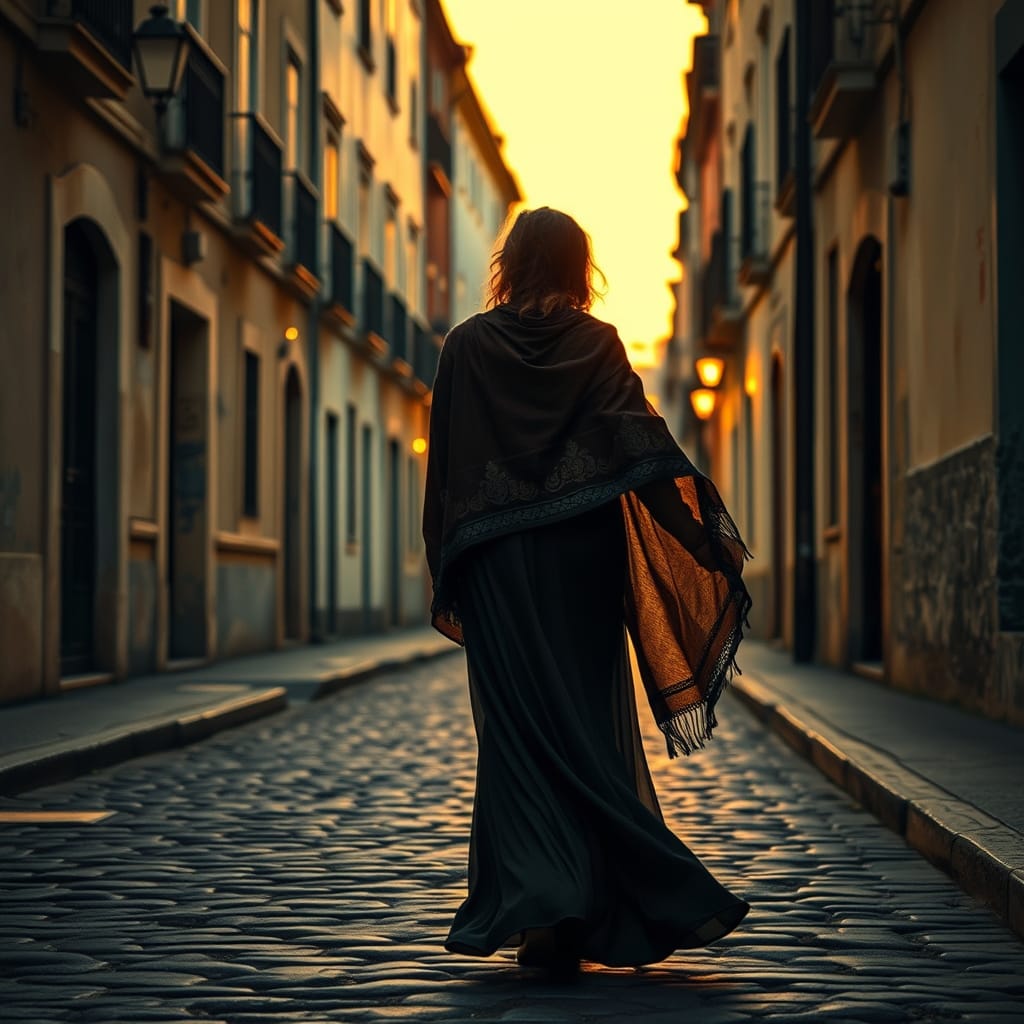
A woman in black with a lantern of flame,
Sings of lost sailors and love without name.
Her voice climbs the stones, where the old trams have been,
Where laundry sways softly and hearts have grown thin.
A guitar responds with a tender refrain,
Like waves kissing rooftops again and again.
It’s not joy, not quite sorrow it lives in between,
In the corners of cafes, where time is unseen.
It lingers in hearts like a kiss that won’t fade,
A memory worn, but never betrayed.
Fado remembers the ones who have gone,
The night with no moon, the silence at dawn.
But still it keeps singing, both broken and bold
A story of Lisbon forever retold.
So sit by the window, let your thoughts drift away,
To a city that sings even after the day.
And if you should weep, let it be soft and slow
For Fado is weeping, and wants you to know.
JH
Artwork by Julan
“You Belong, Bright Soul”
They called you names like broken glass,
Threw words like stones, each meant to pass
Their shadows onto you, but dear,
You’re forged of light, not born of fear.
They saw your quiet, called it weak,
But silence roars when kind hearts speak.
They mocked the way you danced alone
But stars don’t ask for praise to shine.
You are the storm they couldn’t tame,
The ember they refused to name,
The poem scribbled in the night
By hands that dream in black and white.
Unwanted? No. You’re carved from grace
A universe inside your face.
Each scar, a tale of battles braved,
Each bruise, a flag for what you’ve saved.
The bullies bark because they break
They see your joy, and theirs is fake.
But you, sweet soul, you rise and rise
With every tear, you claim the skies.
So lift your head. You’re not alone.
This world is yours. This heart’s your home.
No cruel word can dim your worth
You are the fire that warms the earth.
JH

A Glimpse of Us
We build with hands, we dream with hearts,
We stitch together broken parts.
In every soul, a spark, a flame
A whispered song, a sacred name.
We laugh, we weep, we mend, we try,
We plant our hope beneath the sky.
And in each gaze, a world begins
A million losses, a thousand wins.
If we but look, just still and true
We’d see the light in me, in you.
For humankind, in all its grace,
Is stardust walking, face to face.
JH
The Man with the Golden Tongue
He came with a grin like a curtain call,
A crown of lies, a voice too tall.
He promised light, he sold the stars,
Then paved the streets with prison bars.
He whispered sweet to aching pride,
“You’ve been forgotten, cast aside.”
He kissed the flag with fevered lips,
While freedom sank in sinking ships.
He fed the rich, he starved the poor,
Then blamed the weak, and locked the door.
A gilded cage he called a dream,
Where justice choked on silent screams.
He built a throne on blame and spite,
Turned neighbours into things to fight.
He made the truth a bitter joke,
Then laughed as bridges turned to smoke.
His name in lights, his hands in gold,
He sold the past, the brave, the bold.
And though the world around him burns,
He spins and smiles, and the crowd still turns.
For some are blind, not by the night,
But by a man who dims the light.
A showman’s charm, a hollow hymn
The country bows, but not to Him.
JH

 Julan62